
In 2017 the Cape Town water crisis warns the world about water shortage in high populated areas. Nowadays cities are social and economic complex system where is not anymore possible hope in the rain to have enough water. Climate changes will make the rain statistics of the past 100 years not reliable, heavily distorting the water management and storage.
Less than 1% of all water on Earth is fresh and accessible. This is the water found in lakes, rivers, reservoirs and those underground sources that are reachable at an affordable cost. Only this amount is regularly renewed by rain and snowfall and nearly 70% of that fresh water is frozen in the icecaps of Antarctica and Greenland, whereas of the remaining water, 97% is saline. This is the reason why future of humanity is strictly related to fresh water production from salt water.
The de-coupling of water and power production, is today a worldwide trend and many countries are adopting the use of Reverse Osmosis technology leaving behind the co-generation solutions. In a future sustainable world most of the energy will come from renewable energy where thermal power plants will have network balancing function only, and they will disappear completely in a long term scenario.
Electricity helps humanity to have a better and safe life, however it has been possible because thermal power plant can easily balance the network, where production needs to be equal to consumption. The main question nowadays is how the world can survive with renewable random energy only, and the answer is probably called Virtual Power Plant (VPP).
A recently published book called The Energy Internet, edited by Wencong Su and Alex Huang, define the Virtual Power Plant (VPP) with the following words:
"Virtual power plant (VPP) technology can assemble all controllable distributed energy sources of the energy network to collaborate, integrating their scattered capabilities to serve certain needs of EI. It uses key technologies such as communication, smart metering, data processing, and so forth and could be a framework technology for incorporating various scattered energy sources, such as renewable energy, on a large scale into one powerful source contributing to system operation. The participation of VPP can be a main contribution to various energy service markets, such as ancillary services, carbon trade, and so on. It can also dramatically improve the utilization rate of distributed energy resources, making the whole system work in a more efficient, economically profitable way".
The typical grid configuration has been represented in the picture below, where substation dispatches the power (red lines) gathered from power plants and network.
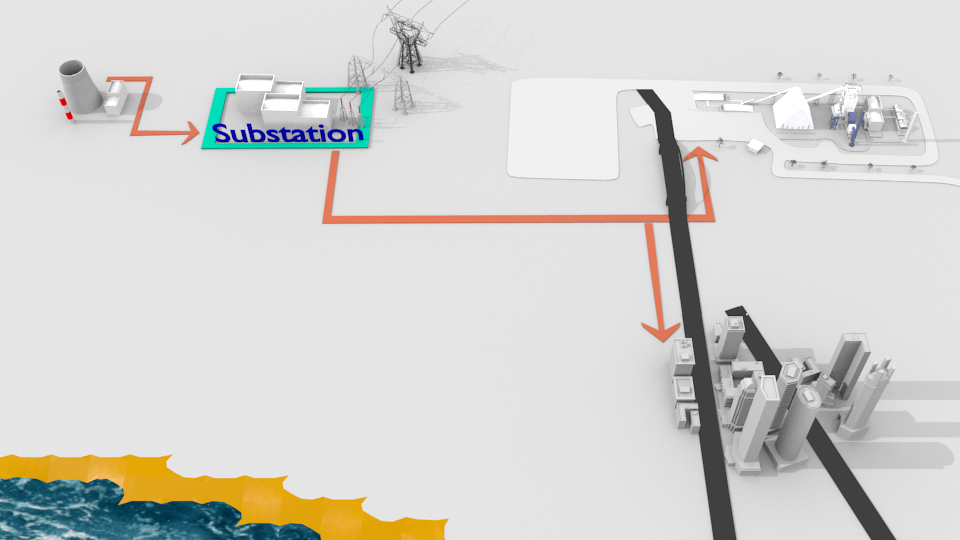
Distribution network Transitions in the electricity sector changes the concept of passive loads in active supplier of energy, exporting to the substation the excess of energy. Traditional power plant are relatively fast to decrease and increase the production, balancing electromagnetic torque and mechanical torque at the generator. Although electronic relays and standard protocol like IEC 61850 made the whole system smart and controllable, the role of the substations remain to distribute passively the input and output energy.
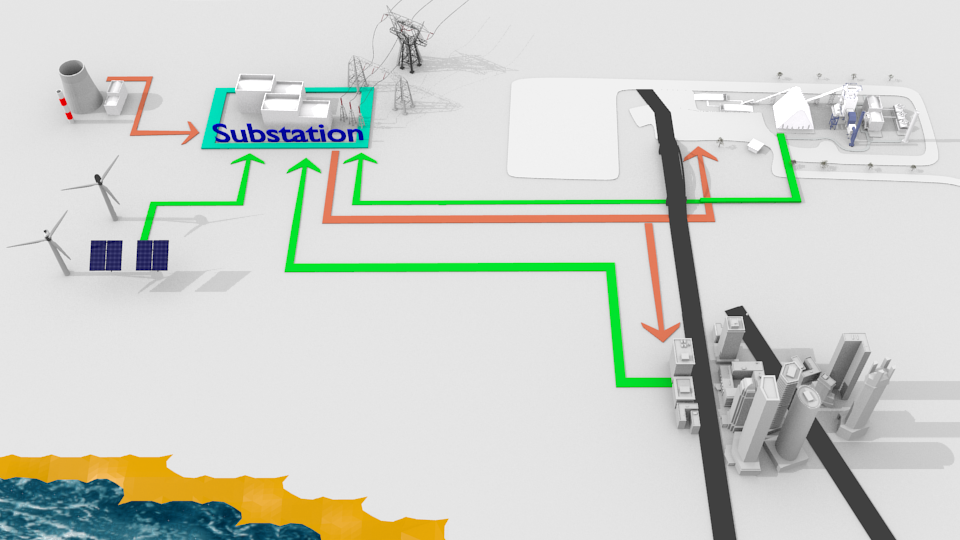
Virtual Power Plant (VPP) is not an infrastructure, but it is a set of small and medium size plants and loads that once controlled by a centralized system may work and act in the energy market in the same way of a traditional large power plant.
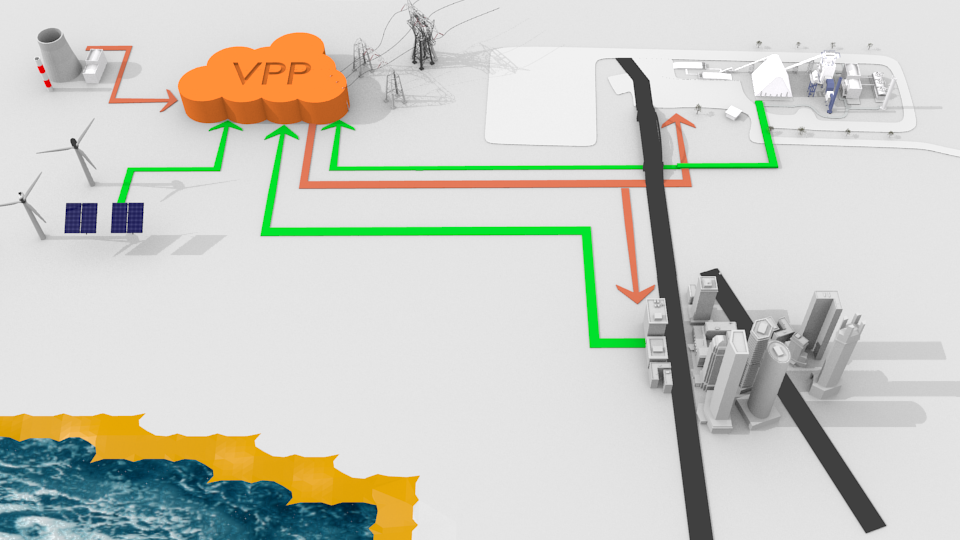
The rapidly increase of renewable energy sources require a non-conventional approach to accept the challenge to operate the electricity system with the variability sources like sun and wind, but integrating in the same picture biomass, heat recovery, CSP and other similar sources.
Communication technology allowed a shift towards in the energy management, however Virtual Power Plant has two main weak point, the unforeseen and variable production of renewable energy sources and the energy storage. The Virtual Power Plant concept requires a mix of several types of sources and loads, where availability, reliability and flexibility need to be ensured through a collective intelligence which receives input and defines the output.
Limit or reduce the production from renewable source is simply a different form of efficiency loss, the target of VPP is drive the production and the consumption in the highest efficient point, which means maximize the energy production from renewable sources without create risk for the network balance. With the actual technology store of electrical energy is possible for limited quantity, it is costly and the related infrastructures are subjected to several variables.
As stated before, human activities require energy and water, where storage of energy is complex and costly the storage of water is simple.
Energy storage is the collection of energy produced over different time periods, using it at later time. Essentially, the energy storage system transforms the energy in work when required. Then, the storage of an vital asset like water may be considered storage of energy, under certain condition.
Being water vital for human activities sooner or later energy shall be used for production and dispatch of water, then why don't use energy when it is available?
Integrate in VPP the water production, storage and dispatching don't considering it as a simple load it is an interesting opportunity.
VPP with Desalination plant
To understand the proposed concept it may be useful consider the most efficient desalination technology (Sea Water Reverse Osmosis) and the most diffused renewable energy source (Photovoltaic).
Considering a water desalination plant able to deliver 100'000 m3 per day with the specific consumption of 3.5 kWh/m3 the continuous load is around 14.6 MW. PV energy production simulation using PVCIS tools shows the hourly production of a 25 MWp in the selected location (ABU DHABI, UNITED ARAB EMINATES Lat (deg N):24.43 Long (deg E):54.65)
The tools may be consulted at following link https://re.jrc.ec.europa.eu/ pvg_tools/en/tools.html.
Results are summarized in the following picture.
Aside from the obvious PV source production benefit in term of sustainability, the plant is able to cover locally significant portion of its own energy needs alleviating the network contribution and defining the forecasted base-load energy supply.
However it is manifest that PV plant(s) cannot satisfy the needs of an industrial plant that work 24h per day. Thus, dedicate a single PV plant, or another renewable source of energy, to a single industrial plant brings limited local benefit only.
Solutions using the plant only during the PV production period, are simple not feasible for technical and economical reasons. A SWRD plant requires a significant investment, and stakeholders need to maximize the production, furthermore it does not make sense shut down and restart a large industrial plant every day.
The up-stream water production is generally governed by local authorities through integrated water management, reducing or increasing the production based on water demand forecast and available reservoir.
Integrate the water management with the VPP will change this paradigm, producing and dispatching the water when energy is available or the energy price is lower. It means that water supplier may produce and dispatch the water based on energy price and not based on authorities request, maximizing the profits in a sustainable way.
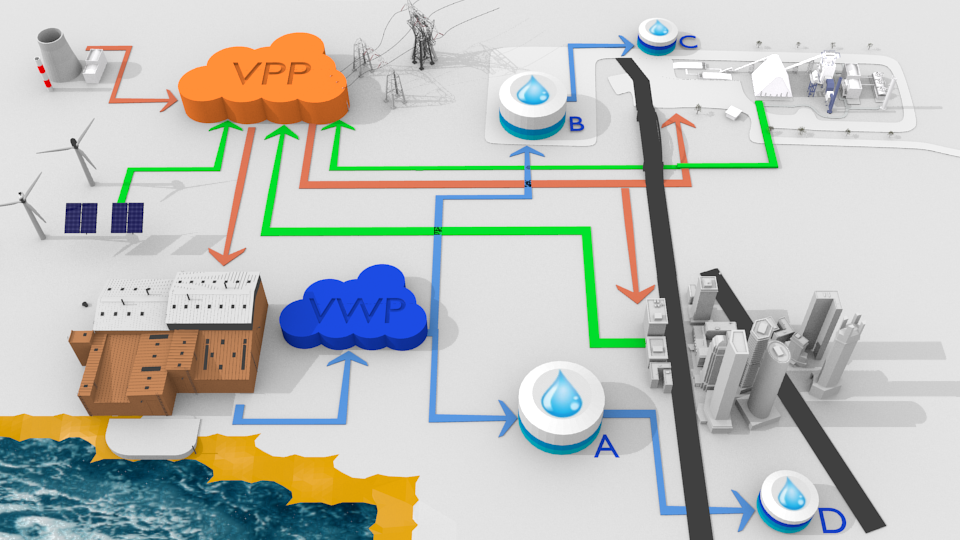
Due to the energy limited storage capacity of the network, energy consumption and production shall match, however creating a sort of Virtual Water Plant (VWP) governed by the Virtual Power Plant make possible to accumulate the energy in a different way.
A Virtual Water Plant may be define as a network of controllable facilities and infrastructure able to produce, accumulate and dispatch water.
From private based system point of you, for example the owner of an industrial site may decide to use the surplus of energy produced by its own PV plant to gather water in the reservoir "C". From public utility point of view it may be required to use the surplus of energy, or the energy at a convenient price, to move the water from reservoir B to reservoir A predicting shortage in reservoir D.
From the energetic point of view the following example may help to understand:
- Water production 3.5 kWh/m3
- Dispatch of water to reservoir C 0.5 kWh/m3 (this value is only to simplified the calculation)
It means that every m3 stored in reservoir is equal to 4 kWh stored in a battery bank.
The full integration of VWP with VPP may require to increase the global water storage infrastructure, but the countries water master plan shall not be established only on the water demand forecast, but the expected surplus of energy, sustainability of the country and network stability shall be included in the equation.
Not all the nodes of water network may have the capability to pump in or out the water, pumping station, tanks (huge ones) and pipes required for the full operability of VWP concept are expensive assets. By carefully balancing the existing infrastructure and the new water facilities the integration with VPP brings significant benefits. The flexible assets can compensate the variations in power flow caused by a lack of wind or sun, or power demand.
In the same way that Virtual Power Plant uses flexible assets like hydro power, biogas and cogeneration units to compensate demand peak, VWP may be use to compensate production peak without cutting off the renewable energy production.
Where the Grid governor promptly reduce the output of connected traditional power plants to react to a surplus of wind or solar power, a VPP+VWP balances fluctuation in power production and load, accumulating energy in terms of work and water storage without stressing the public grid.
Government and local authorities shall estimate the water production capacity developing the economy of the country considering agriculture, animals farm and other activities related to real economy that can grow thanks to the water. Develop an economy driven by sustainable water and energy production required initial investment highly paid back in countries long term scenario.