
In small, large or medium industrial plants it is nowadays common practice a large use of Low Voltage Variable Speed Drive to control the process. Drives are fundamental to control the process in a smart and safe way, but the most important factor is the energy saving. The utilization of drives bring to the designers thousands of benefits and high flexibility whereas give to the client the possibility to save huge amount of money during the lifetime of the plant.
Usually, designers use only a limited quantity of functions included in the Drive, functions that may simplify the final installation increasing control and monitoring capabilities of the whole system. Designer tend to install the Drive as additional equipment in a typical motor line installation, a good example of this concept is the contactor installation, then the question is, is the contactor still required installing a drive with STO function?
Working in the water and power sector most of the designer doesn’t consider the STO in their own design, maybe to do not change the company standards and drawings or because STO function is still a mystery for them.
Most of the main manufacturer of drives includes safe torque off (STO) function in their product by default, so don’t use the STO function is not a way to save money during the procurement of those equipment.
It would be useful to investigate, from normative and technical point of view, if contactor is still necessary where Drive with STO is installed. Starting from the definition of contactor and STO, it is possible to identify if those two entities may live together or one of them is useless. It would be useful also bring some example from the power and water sector.
Contactor — definition and categories (IEC 60947-1)
The contactor shall be “capable of making, carrying and breaking currents under normal circuit conditions including operating overload conditions”. It means that contactor shall be used only in defined normal condition with some additional function depending of the application (e.g. motor starter).
The categorization of IEC 60947-1 is:
AC-1 — This category applies to all types of a.c. load with a power factor equal to or greater than 0.95. Application examples: heating, distribution.
AC-2 — This category applies to starting, plugging and inching of slip ring motors. On closing, the contactor makes the starting current, which is about 2.5 times the rated current of the motor. On opening, it must break the starting current, at a voltage less than or equal to the mains supply voltage.
AC-3 — This category applies to squirrel cage motors with breaking during normal running of the motor. On closing, the contactor makes the starting current, which is about 5 to 7 times the rated current of the motor. On opening, it breaks the rated current drawn by the motor. Application examples: lifts, escalators, conveyor belts, bucket elevators, compressors, pumps, mixers, air conditioning units, etc.
AC-4 — This covers applications with plugging and inching of squirrel cage and slip ring motors. The contactor closes at a current peak which may be as high as 5 or 7 times the rated motor current. Breaking is severe. Application examples: printing machines, wire drawing machines, cranes and hoists, metallurgy industry.
Hence, contactors are designed for operational switching and they have no short-circuit switching capacity and must be protected against the effects of short-circuit currents. It is really common see wiring diagrams where contactors are directly connected to a protection relay, but unfortunately this is not the function of contactors. Even if Contactor used as motor starters shall withstand LRA and FLA currents, the short circuit current may be higher.
Safe Torque Off (STO)
Getting the information from main drives manufacturers, it is simple to summarize the Safe Torque Off definition as follow:
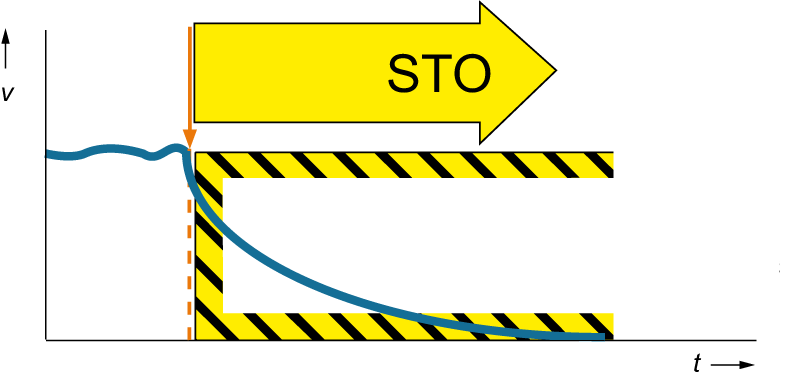
Safe Torque Off is drive-based functional safety that prevents the drive from generating torque in the motor. STO is typically used to prevent unexpected startup (EN 1037) of machinery or for emergency stop, complying with stop category 0 (EN 60204-1).
Fortunately the stop categories in the following standard are closely harmonized: ISO 13850 (Emergency stop), IEC 60204-1 (Safety of machinery — Electrical equipment), and NFPA 79 (Electrical Standard for Industrial Machinery).
The stop category 0 switches the motor into a no-torque state in the time required by the inertia of the motor when the STO is activated.
In a nutshell, STO function removes immediately the energy transferred to the motor like a contactor opening do. Hence, being the effect the same, it is correct to say that Safe torque-off brings the stopping function of the contactor into the drive.
Why designers still install contactors?
The common justification is “STO shall be used for emergency stop only” whereas the contactor is used to start and stop the motor. Well, this is partially true, because STO shall be used also for unexpected startup, which it is the same function of the contactor, which shall stay open until a command from DCS or PLC allows it to close and start the operation.
However, the common mistake of designer is believe that closing the contactor will start the operation, but it is totally wrong for a motor under drive. To start the motor under drive it is required to have the following condition:
- The drive shall receive the power from the network
- The drive shall receive start/enable command from DCS/PLC
- The drive shall receive the speed reference command
It means that closing the contactor may satisfy only the first condition, but the motor will remain in no torque status.
As clearly stated by manufacturer, contactor shall not be used to start and stop the inverter. For example, Mitsubishi FR-A800 manual warns: “Do not use a magnetic contactor on the inverter input for frequent starting/stopping the inverter”.
Also ABB ACS880 manuals include warnings about contactor proper utilization. Opening the contactor during normal operation will result in a loss of network from the point of view of the drive, and it will probably try to maintain the motor speed with the “catch on fly” function. The drive will not know why there is no energy from the network.
The proper way to stop the motor controlled by a drive is to send the stop command through DCS/PLC. Hence, in a motor line with a drive, contactor cannot be used for start and stop the motor. Thus, the only function of the contactor is the emergency stop, for no electrical anomalies like ANSI 12,38 or 39. But, it is exactly the same function of STO.
Maintenance and safety note
Regarding maintenance it is required to remember that STO does not provide electrical isolation, and before any intervention in the motor, it should be isolated by cutting the supply to the inverter opening circuit breaker or disconnector switch where the line is protected with fuses. It is honestly the same operation required also where magnetic contactor is installed. Indeed, no one shall operate manually in the motor with only the contactor open, but the supply shall be properly removed with the proper device (breaker or disconnector).
Usually STO needs two NC contacts wired in the drive; if one of them is open, drive cannot dispatch energy to the motor. Having two different NC contacts, STO is reliable and gives to designer high flexibility.
Conclusions
Concluding this long discussion, it is clear that contactor is not useful where drive with STO is installed. Designer should use technology progress to simplify the system, saving money, time for installation and avoiding to waste materials and resources just to follow an old and obsolete design concept.